
Arrest Warrants in Avoyelles County
In Avoyelles County, an arrest warrant is a judge's written order telling a peace officer to bring a named or described person into custody. It takes more than an accusation. A magistrate signs one only after a sworn statement lays out probable cause. The usual route starts with a complaint or affidavit from law enforcement. Under Louisiana Code of Criminal Procedure art. 202, any magistrate may issue an arrest warrant on that showing, and fax, telephone, or electronic procedures are allowed in specified circumstances.
The 12th JDC and Avoyelles Arrest Warrants
The 12th Judicial District Court is the parish-level trial court for felony and other district matters in Avoyelles County. Its judges issue district-court arrest process, and the Avoyelles Parish Clerk of Court keeps the filings. One catch: the Clerk's online search carries no criminal information, so a district-court warrant check runs through the office directly. In practice, the pieces connect fast. An official Sheriff's Office account from 2024 described the local sequence: an investigation produced probable cause, a 12th Judicial District judge issued arrest warrants, and law enforcement made arrests. A 2026 Attorney General release reported state investigators executing a 12th Judicial District warrant in a Cottonport police matter.
What an Avoyelles County Arrest Warrant Contains
Article 203 spells out what a written Avoyelles County arrest warrant contains. The list is exact. It must carry a Louisiana designation, the issue date, the parish, a name or identifying description, the offense, a command to arrest and book, the magistrate's signature, and any bail amount in noncapital cases.
| Warrant Number | The issuing court's warrant or docket reference. Formats vary. |
|---|---|
| Person Named or Described | A name, or an identifying description when the name is unknown. |
| Charge or Offense | The offense stated in the process. A charge is not a conviction. |
| Issuing Court or Magistrate | The 12th Judicial District Court, a city, mayor's, or Justice of the Peace court. |
| Bail or Release Condition | An amount or condition only where the law authorizes one. |
| Date Issued | The date the magistrate signed, not the date of an arrest. |
The Louisiana Legislature publishes the written elements at legis.la.gov.
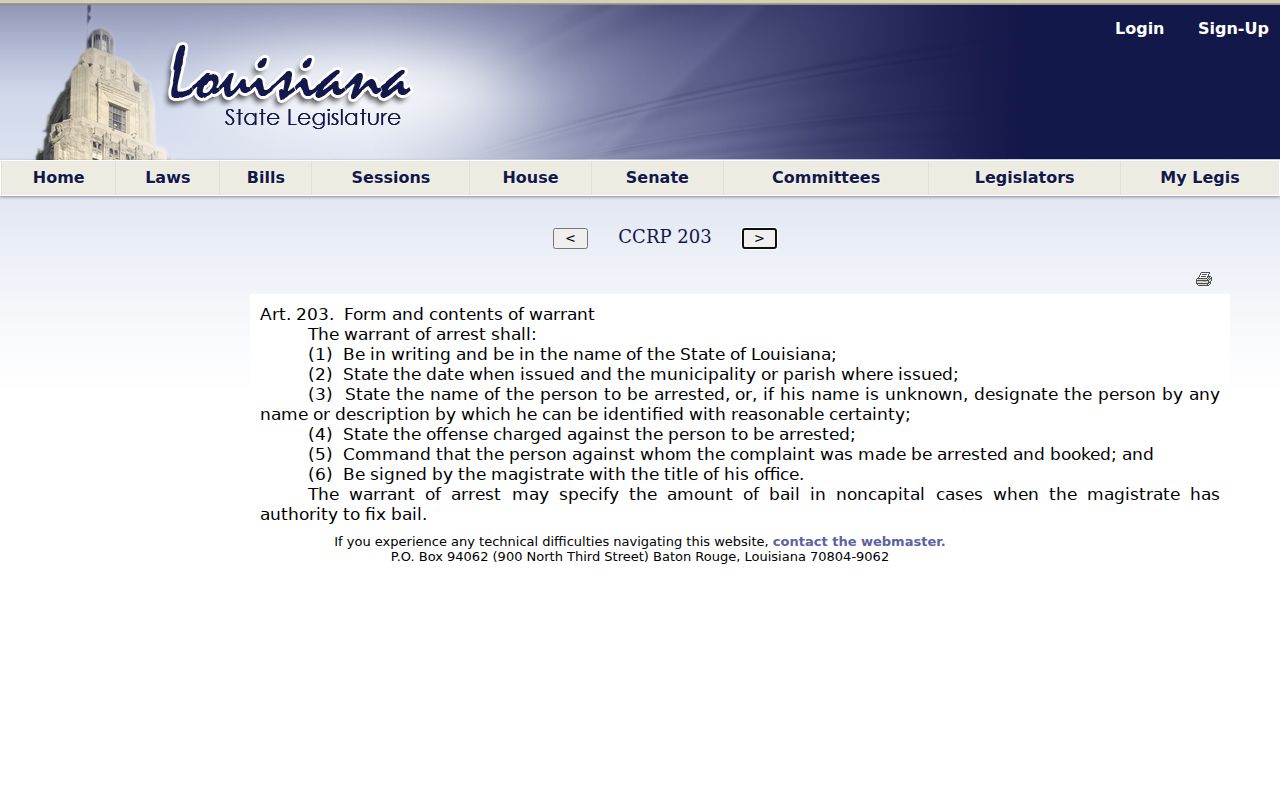
Those elements shape Avoyelles County arrest warrants from any court that issues one.
Reading the Dates on Avoyelles Arrest Warrants
An Avoyelles County warrant record can carry several dates, and each one means something different. The issue date marks when the magistrate signed. The execution date shows when a peace officer arrested or served the person. A recall date records when the issuing court withdrew the process.
- Issue Date
- When the magistrate signed the warrant.
- Execution Date
- When an officer served or arrested under it.
- Return
- The officer's report of what happened to the process.
Note: A recall entered in Avoyelles County court and a law-enforcement database update are separate events, and the second can lag the first.
How Avoyelles County Arrest Warrants Are Served
Louisiana law puts execution of an arrest warrant on a peace officer. In Avoyelles County, the Sheriff's Office runs a Warrants Division inside its Patrol Bureau, and courthouse deputies take people into custody on active warrants. City marshals and constables handle city-court process under their own authority. Where does service happen? Wherever the person turns up: a residence, a workplace, a traffic stop, or the courthouse. An officer with authority can execute the warrant anywhere in the parish, and a close-pursuit rule covers a chase across a boundary. After the arrest come booking, a first appearance, and a bail decision.
Avoyelles Arrest Warrants Outside the Parish
An Avoyelles County arrest warrant can reach past the parish line. When the person turns up in another jurisdiction, the arrest depends on the authority the officer holds there, and someone arrested away from the originating court can post bail under the out-of-jurisdiction procedures. Separate holds complicate things. A detainer from another agency can keep a person in custody even after the local warrant is resolved, so ask about every hold on the record.
Arrest Warrant vs Summons vs Bench Warrant
In Avoyelles County these three instruments are not interchangeable, and the difference decides how a person responds. See bench warrants for the companion detail.
| Feature | Arrest Warrant | Summons | Bench Warrant |
|---|---|---|---|
| What It Orders | An arrest and booking | An appearance on your own | An arrest for a missed obligation |
| Basis | Probable cause of an offense | A charge not requiring custody | Failure to appear or comply |
| Who Issues It | Any magistrate, including a 12th JDC judge | A court or authorized officer | The judge handling the case |
| How to Respond | Surrender, bond, or counsel | Appear on the date ordered | Address the recall and appear |
Note: Article 211 lets an Avoyelles County court use a summons instead of arrest in eligible misdemeanor cases.
When Avoyelles Recalls an Arrest Warrant
Under Article 202, the magistrate who issued an Avoyelles County warrant may recall it, and must notify the district attorney and the executing agency. A recall is a court action, not a payment or a promise. So get proof. Ask the issuing court for a filed order or other official confirmation, then ask the Sheriff's Office to verify that the law-enforcement database was updated, because a verbal statement from outside the court does not clear the record.
Avoyelles Arrest Warrants vs Federal Warrants
Federal arrest warrants are a different world from anything Avoyelles County courts issue. They come from a federal court, and Avoyelles sits in the U.S. Marshals Service Western District of Louisiana coverage area. Federal dockets live on PACER, the judiciary's own system. It charges $0.10 per page with a $3 cap on most documents, and it is not an open-warrants database. Keep the two tracks separate. A parish check will not surface a federal warrant, and a federal docket search will not clear a local one.
What to Do If There's a Warrant for You
Find out which court issued the warrant before anything else. For a 12th Judicial District case, call the Avoyelles Parish Clerk of Court at (318) 253-7523 and ask which division has it. The Sheriff's Office at (318) 253-4000 handles the enforcement side. It cannot speak for the judge or the Clerk.
- Confirm the warrant and its current status with the issuing court.
- Ask whether the court requires a motion, an appearance, a surrender, or bail.
- Talk with a Louisiana attorney or the public defender.
A few paths can resolve an Avoyelles County warrant. They are a voluntary surrender, posting bail under a form the law allows, and a motion to recall or quash. A voluntary appearance is treated differently from an arrest and may carry conditions.
Important: Talk with a lawyer before a voluntary surrender, a bond payment, or a motion to recall, and never send money to a caller who demands it.
Requesting an Avoyelles Arrest Warrant Record
Anyone in Avoyelles County can pull an arrest warrant record under the Louisiana Public Records Law, La. R.S. 44:1 et seq., though exemptions apply. Put your request in writing. Name the specific record, the court or agency holding it, the date range, and the format you want back. Under R.S. 44:32, you may inspect the file, and the office can verify who you are and charge for copies. Not everything comes out, though. R.S. 44:3 protects law-enforcement and pending-investigation material, so the warrant itself, its affidavit, and the return can each carry a different disclosure status. If the office never answers in time, R.S. 44:35 gives you a court remedy. When you write to Avoyelles County, ask for three things separately: the docket, the warrant, and the current status. Those three often sit in different files.